The dehumanizing conditions of laundry work
Martin EdenThe dehumanizing conditions of laundry work are presented as an organized assault on Martin Eden’s time, body, and inward life. In the hotel laundry, modern machinery and practiced skill make it possible to process enormous quantities of clothing, but the work’s efficiency does not lighten the workers’ burden: it intensifies the pace, extends the day, and narrows Martin’s attention until he can scarcely think beyond the next garment. The laundry brings the distance between productive labor and the leisure it serves into sharp view. While hotel guests enjoy cool verandas and clean linen, Martin and Joe Dawson sweat through hours of work that leave little space for reading, rest, or a sense of being fully human.
The work and its machinery
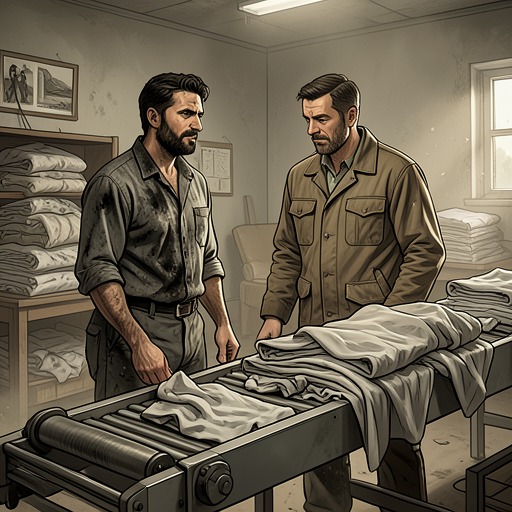
The laundry is a small, well-equipped steam operation in which machinery performs nearly every task it can. Martin begins by sorting heaps of soiled clothes, then helps wring them in a rapidly spinning receptacle that uses centrifugal force to extract water. He moves between dryer and wringer, shakes out socks and stockings, feeds garments through the mangle, and eventually irons and folds the finished clothing. Joe handles the masher and prepares soft soap from biting chemicals; to protect his face, he wraps bath towels around his mouth, nostrils, and eyes. The process is modern, but its human operators must adapt their bodies to it at every stage.
The pace quickly turns a day’s work into a race against an unfinished load. When Martin and Joe are behind, they return after supper and work until ten at night beneath electric lights. On a hot California evening, open windows cannot relieve the heat of the room and its red-hot ironing stove. Down to their undershirts and bare-armed, the two men sweat and pant while they finish the last underclothes. The next day brings the same unremitting routine. Joe’s speed impresses Martin, who watches him save time by reducing a task to fewer motions; Martin learns the work by copying his partner and takes pride in matching his brisk, deft pace.
The work demands fine control as well as speed. In one afternoon, the two men account for two hundred white shirts. Joe uses a machine with a hot iron suspended from a steel string to finish the yokes, wristbands, neckbands, and bosoms; Martin catches the shirts and irons their unstarched portions. For a precise result, they judge the irons’ temperature by holding them close to their cheeks. If an iron is too hot, it must be dipped in cold water, but even a fraction of a second too long can spoil the heat needed for the fabric. Accuracy becomes automatic, calibrated to the machine’s demands, while there is little time to pause over the skill itself.
Escalating hours and shrinking life
The laundry’s workload is not limited to ordinary clothing. Twice a week, the workers process the hotel’s sheets, pillow slips, spreads, tablecloths, and napkins. They also handle fancy starch: delicate garments that require slower, more careful work and can be costly to scorch. A filmy corset cover, Joe warns Martin, could cost him twenty dollars out of his wages if damaged. Martin therefore eases the force of his movements while his nervous tension rises. The task becomes a nightmare for both men, not because it is simple, but because its delicacy consumes time they do not have.
As extra work arrives, the schedule grows more severe. The men bolt their meals, work late under electric lights, and sometimes get half an hour of labor in before breakfast. On one long night, they break at seven to run the hotel linen through the mangle, then return to fancy starch until half past two in the morning. Saturday’s work continues until three in the afternoon, when the week’s load is finally done. These hours make rest a brief interruption in production rather than a secure part of life. Martin stops taking cold baths, and the exhaustion leaves him with little appetite for newspapers or news; even his plan to travel to Oakland by bicycle is shaped by the cost of the train and the need to save money.
The contrast between the laundry and the hotel’s public spaces makes the arrangement plain. On the broad verandas, guests in cool white clothing sip iced drinks and avoid the heat. Inside, the workers produce the linen that supports that comfort, amid roaring stoves, hot irons, and clouds of steam. The guests’ coolness and the laundrymen’s exertion belong to the same hotel economy, but the comfort is distributed unevenly. The clean shirts and delicate garments appear ready for use; the labor, sweat, and precision that make them so are confined to the overheated room.
Attention reduced to the next task
The most profound effect on Martin is the occupation of his mind. At sea, work had left him intervals in which to commune with himself; the ship’s master controlled his time, but the hotel manager seems to control his thoughts as well. In the laundry, Martin’s attention is consumed by nerve-racking, body-destroying toil. Ruth Morse recedes from awareness and returns only in fleeting memories when he crawls to bed or rises for breakfast. The work does not simply make him tired after a day of thought: it prevents sustained thought from taking place during the day at all.
The narrative renders this narrowing through the image of an intelligent machine. Martin’s hands and judgment remain active, but the broad corridors of his mind close; his inner life contracts to a small directing station for his arms, shoulders, fingers, and iron. Each stroke must travel the right distance, each garment must be moved without wasting motion, and the finished shirts must be tossed onto the receiving frame without rumpling. The next shirt is already within reach as the last is completed. This repeated cycle shows how a worker’s intelligence can be used in the service of the task while the rest of his mental life is excluded from it.
Even conversation threatens the rhythm. When Joe remarks on the misery of the work, Martin feels irritated because the observation breaks his concentration; he misses a stroke and has to make extra motions before recovering his pace. Such a moment shows how fully the job governs not only what the workers do, but also the terms on which they can speak. In the most demanding stretches, the task fills the available attention so completely that there is no room for the larger questions that once occupied Martin.
Weekends, exhaustion, and recognition
Martin tries to preserve a separate life by cycling between the hotel and Oakland. After a week’s work, he rides the seventy miles there and covers the same distance back on Sunday, then begins another week tired. Joe questions whether such a journey is possible on top of the labor. Martin nevertheless sets out, oiling his bicycle and adjusting its bearings before he rides. The trip gives him a goal beyond the laundry, but it is not recovery: in the following weeks, the repeated 140-mile round trip becomes another extraordinary exertion layered onto an already exhausting one.
By the fifth and sixth weeks, Martin lives and works like a machine, sustained by only a spark of something beyond the routine. The weekend ride briefly asserts that remaining spark, yet its punishing distance helps crush it rather than restore it. At the end of the seventh week, too weak to resist the pull of the moment, Martin goes down to the village with Joe and drinks. On the following Saturday, after the week’s work ends, Joe heads toward the saloon while Martin suddenly sets off on his bicycle again. He completes the ride and returns in time for Monday’s work, having kept sober that weekend; the escape has not, however, changed the conditions to which he returns.
After three months, Martin goes to the village with Joe again and drinks. In that state of temporary release, he sees what the work is making of him. He understands drink not as the original cause of his deterioration but as an effect that follows from the labor, as night follows day. Alcohol seems to disclose a truth he can recognize: becoming a beast of toil cannot carry him to the heights he seeks. That recognition marks a decisive change in how he understands his decline. The laundry has made him physically and mentally numb, but the episode also sharpens his awareness that survival through work at any cost is incompatible with the life he wants.
Narrative significance
The laundry episode makes labor’s damage cumulative rather than sudden. No single shirt or late night accounts for Martin’s transformation; the harm builds through repeated shifts, lost reading time, curtailed rest, bodily exhaustion, and the gradual disappearance of thought. The repeated image of machine-like work describes both the tools and the worker: machinery organizes the process, while Martin’s intelligence is recruited to keep pace with it. The contrast between the laundry’s scorching interior and the guests’ cool verandas gives that private exhaustion a social setting, linking comfort on display to labor kept out of sight.
The episode also tests Martin’s earlier faith in effort. He is capable, eager to learn, and proud of doing his own work well, but competence does not protect him from the conditions surrounding the job. His speed helps him meet the laundry’s demands; it does not grant him control over the day or restore the time for reading and writing that the work consumes. His final insight therefore does not deny the role of drink in his immediate escape. It places that escape within a larger chain in which relentless toil strips away the life that would make endurance meaningful.